
Demographics and retirement
Your future pension depends on more than your salary, years of insurance and retirement age. The demographic environment also matters: how many people pay contributions, how many receive a pension and how long those payments continue.
How the first pillar works
The first pillar is a solidarity-based, pay-as-you-go pension system. It is closely linked to economic activity and household income.
In simple terms, the system works as follows:
- employees and employers pay contributions
- the contributions enter the social insurance system
- the system finances current pension payments
 employees and employers pay contributions
 the contributions enter the social insurance system
 the system finances current pension payments
The main change by 2050
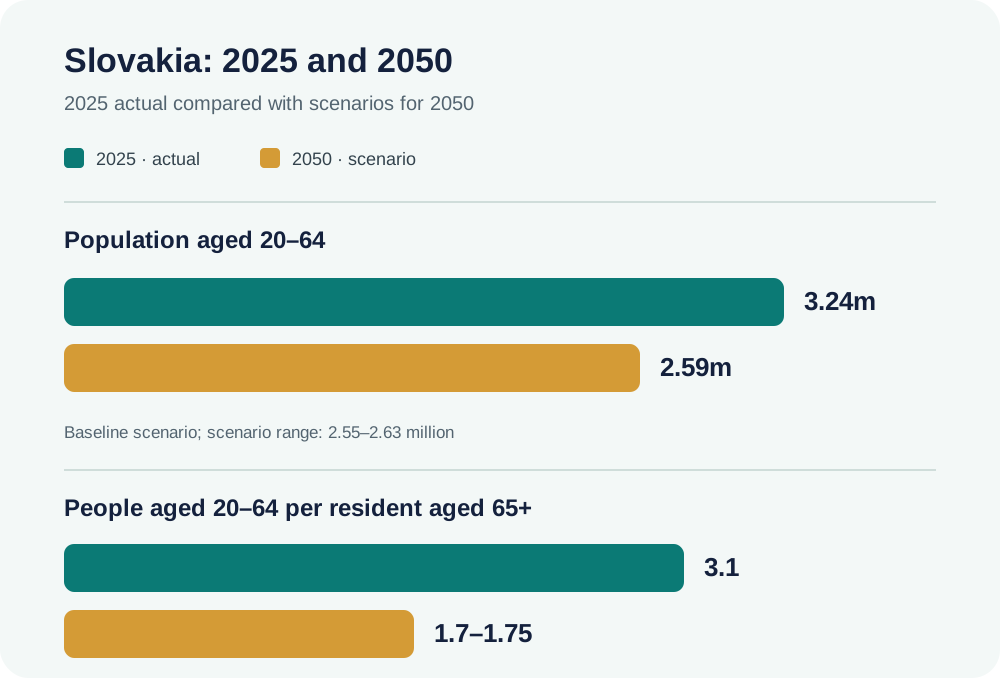
In 2025, Slovakia had approximately 3.24 million people aged 20–64. In scenarios for 2050, this group falls to between 2.55 and 2.63 million; the baseline scenario gives 2.59 million.
In 2025, there were approximately 3.1 people aged 20–64 for every resident aged 65+. In the scenarios for 2050, this ratio falls to 1.7–1.75.
Why the population is ageing
Researchers Branislav Šprocha and Pavol Ďurček link Slovakia's accelerating population ageing to a sharp fall in fertility, longer life expectancy and an uneven age structure formed by earlier demographic waves.
According to the Statistical Office of the Slovak Republic, Slovakia had 5,409,407 residents at the end of 2025. The population had declined for a fifth consecutive year, and positive net migration did not offset the natural decrease.

Eurostat confirms the direction of travel: from 2015 to 2025, the share of Slovakia's population aged 65+ rose by 4.8 percentage points, one of the largest increases in the EU.
What this means for the pension system
Consider a simplified example with 100 workers and 30 pensioners. The workers pay contributions that finance current pensions. If the number of workers falls to 70 while the number of pensioners rises to 40, each contributor carries a greater financial burden. This illustrates the mechanism; it is not a forecast of worker or pensioner numbers.
- There are more people of retirement age, and pensions may need to be paid for longer.
- The group of potential workers is shrinking, which may reduce the number of contributors.
- Contribution revenue depends on more than demographics, including employment, wages and income.
- The balance between system resources and pensioner numbers changes, increasing financial pressure.
- The state may adjust the system's rules, including retirement age, contribution rates and payment conditions.
Demographics do not predetermine an individual's future pension, but they change the conditions in which the first pillar operates. The second and third pillars can supplement future retirement income and spread it across several sources.
Retirement as a personal financial goal
It is worth defining your desired retirement income in 20–45 years as a separate financial goal.
A personal plan should estimate:
- how much money you will need each month in retirement and for how long;
- how much of those expected needs the first pillar may cover;
- which additional tools fit your time horizon, circumstances and attitude to risk.
These calculations cannot guarantee a future amount, but they can reveal a potential gap and help you prepare your own plan early.
Useful materials
- The ageing of Slovakia's population over time and across regionsAn SAV monograph on ageing, age structure and demographic burden.
- Regions and districts in demographic perspectiveAn SAV population forecast to 2040 for Slovakia's regions.
- Demographic development and migration in the context of ageingA study of the wider links between ageing, migration and the economy.
- Demographic development in 2025Current Statistical Office data on population, natural change and migration.
- Population structure and ageingEuropean statistics and an explanation of long-term changes in age structure.
- First-pillar pension insuranceThe official explanation of financing principles and pension payments.
- Branislav Šprocha's publicationsThe official SAV list of the author's demographic research.
Take the first step towards financial well-being
Schedule a meeting and together we will find the best solution for you.
 Schedule a meeting
 Call me